Every FDA Cybersecurity Recall, Analyzed (2008 to 2026)
In June 2026, CMR Surgical recalled one of its surgical robots. FDA's record gives the reason in one sentence:
“Secure Boot was mistakenly not enabled at manufacturing time, which presents a potential cybersecurity risk.”
The robot was designed with Secure Boot. One missed step on the production line turned that into a federal recall, posted in a public database where competitors, customers and FDA reviewers can all read it.
We wanted to know how often this happens and what manufacturers keep getting recalled for, so we read every cybersecurity recall FDA has on file. There are 53. The older ones are about vulnerable code and insecure radio links. Since 2023 they increasingly look like CMR's: security that existed in the design but not in the field, or a login that let the wrong person in.
That is good news for anyone building devices now. Of the 37 recalls where FDA describes the flaw, 30 fall into categories a standard medical device penetration test already covers. Below is what the recalls have in common, what to fix first, and a 10-point self-check you can run against your own device.
Cybersecurity recalls hit a record in 2025
2026 (gray) is a partial year: data through FDA's Oct 30, 2026 export, and FDA posts recalls a median of 45 days after initiation. Years with no events are shown as zero. Source: openFDA device/recall, Extra Security analysis.
FDA logged 25 cybersecurity recall events from 2008 through 2022, and 28 in the 46 months since. 2025 had 13, the most of any year. 2026 has 7 so far, and that number will climb because FDA posts a recall a median of 45 days after the company starts it.
The jump follows section 524B of the FD&C Act, which took effect on March 29, 2023, and FDA's final premarket cybersecurity guidance from September 2023, which FDA revised in June 2025 and again in February 2026. Recall records don't say why a problem came to light when it did, so we can't prove the rules caused the rise. They do show clearly that the kind of problem changed.
The flaws moved from code to access
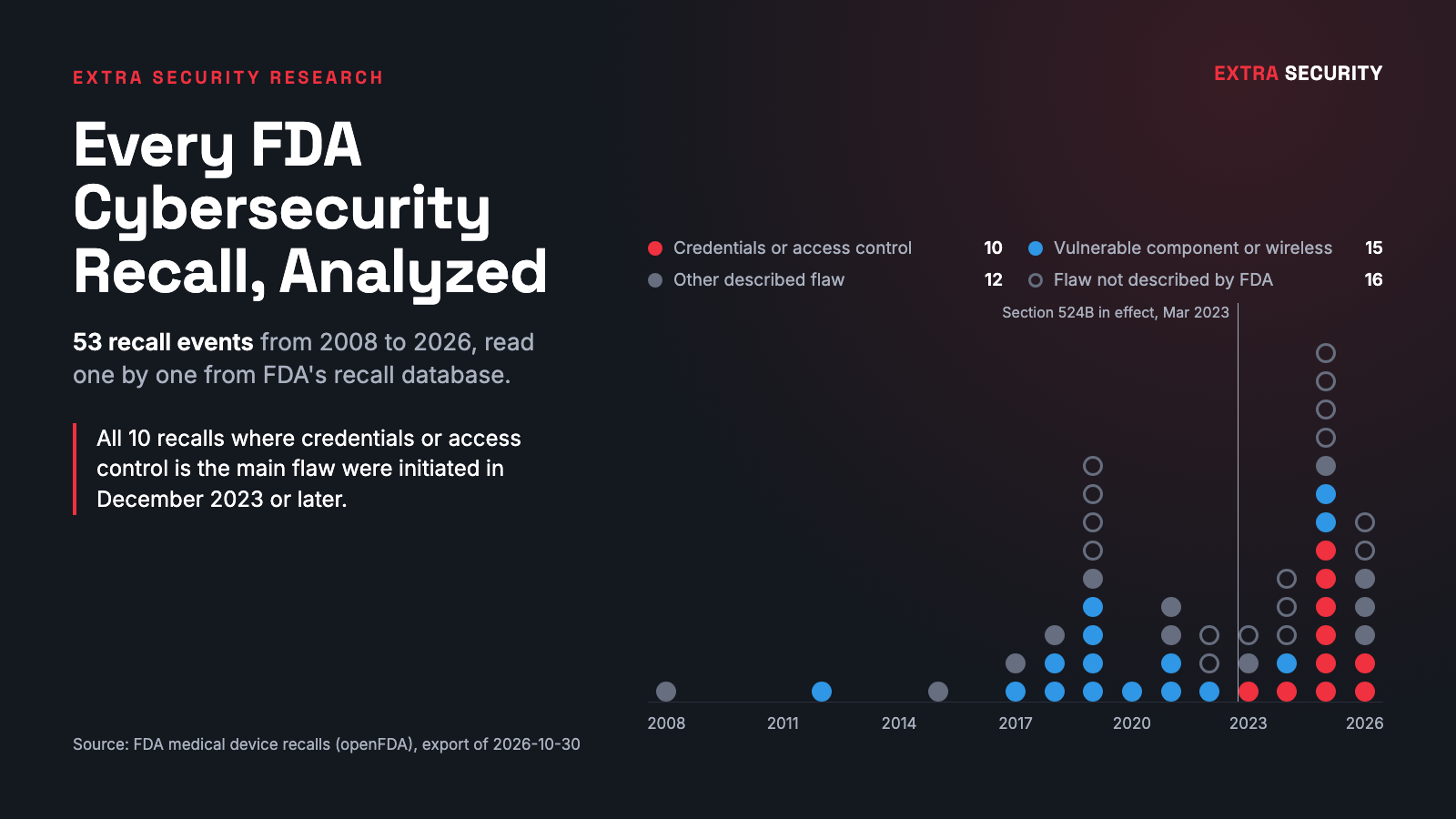
Recall events by the flaw FDA's record describes. 2023 onward runs through FDA's Oct 30, 2026 export.
Before 2023, most cybersecurity recalls traced to known vulnerabilities in common software, such as the Windows Remote Desktop and Print Spooler flaws and the Ripple20 TCP/IP stack, or to the wireless links of St. Jude Medical and Medtronic cardiac devices and insulin pumps, where FDA's records describe unauthorized wireless access, a vulnerable remote controller, or weak telemetry. Seven of those 25 recalls involved Class III devices, compared with two of the 28 since.
Then a new kind of recall started. Recalls where the main flaw is credentials or access control first appear in December 2023, and there have been ten since. Nine of the ten are hospital systems: imaging systems, a patient monitor, a cardiology data system, an anesthesia cabinet, drug library software and lab systems.
The credential recalls are the uncomfortable ones, because three of the five involved service or support accounts. BD recalled products twice, in October 2024 and September 2025, after "product service credentials used by some BD technical support teams to access certain BD products were accessed by an unauthorized actor." GE HealthCare had three: service login credentials that could be identified, an administrator credential that could be used from the local network, and user credentials left exposed on a client workstation. That last one is the subject of our earlier post, It Was Just Cached Credentials.
The numbers are small, and FDA doesn't describe the flaw in 10 of the 28 recent recalls, so some of the shift may come down to what gets written up. Going from none to ten in under three years is still a change worth planning for.
- Credentials or access control 10
- Vulnerable component or wireless 15
- Other described flaw 12
- Flaw not described by FDA 16
Select any dot to see the recall: firm, device, recall class and FDA's stated reason.
Stacked by the year the firm initiated the recall, colored by the flaw FDA's record describes. 2026 is a partial year. Select a dot for details and a link to FDA's record.
A cybersecurity recall can stay open for years
Four of the 53 events are Class I, FDA's most serious category, reserved for a reasonable probability of serious adverse health consequences or death. Three of the four came in 2025:
| Initiated | Device | What FDA's record says |
|---|---|---|
| Aug 7, 2018 | Medtronic insulin pump remote controller | A potential security vulnerability related to remote controller accessories |
| Apr 7, 2025 | Baxter facility ventilator | A cybersecurity vulnerability discovered through internal testing |
| Oct 1, 2025 | Abiomed Automated Impella Controller | Potential vulnerabilities related to the controller's operating system |
| Dec 29, 2025 | WHILL powered wheelchair | A Bluetooth Low Energy vulnerability found through CISA's disclosure program |
Baxter found its vulnerability through its own testing, and FDA still classified the recall Class I. Classification follows the risk to patients, whoever finds the problem.
Recalls also take a long time to close. FDA lists 36 of the 53 events as still open, and the 15 that closed took a median of 1,058 days, nearly three years. Medtronic MiniMed's 2019 recall, in which "an unauthorized person could potentially connect wirelessly to a nearby insulin pump to change settings and control insulin delivery," covers 16 products and is still open more than seven years later. A weakness in a wireless protocol often can't be patched in the field, so the fix is a replacement device.
How to stay out of the next update
These five recommendations come straight from the recalls above. If we were reviewing your device, this is the order we'd work in.
Put service and support access in scope
5 credential recalls since October 2024, 3 involving service or support accounts
Threat models and penetration tests usually center on the clinical user and the hospital network. The recent recalls point somewhere else: the field service laptop, the remote support tool, the service account shared across a fleet, and the client software that caches a login. Give each device or site its own service credentials, keep credentials out of client software and off workstations, rotate them when support staff change, and log every service login.
Test every role, including on the device itself
5 recalls where access control is the main flaw, all since December 2023
The access control recalls include an unauthorized user who could modify and approve an infusion pump drug library, privilege escalation on a patient monitor, and an insulin pump lock screen that tapping the status-bar icons could get around. Automated scanners rarely catch flaws like these. Someone has to work through each role against each function with a low-privilege account, and try to get past lock screens and limited modes with the device in hand.
Check the security settings on the units you ship
CMR Surgical 2026; CareFusion 2025 and 2026
Besides CMR, CareFusion recalled anesthesia cabinets in 2025 because antivirus software "was not consistently installed on impacted devices during the implementation process," and in 2026 recalled infusion pump labeling that didn't say which TLS version hospitals needed to enable for secure Wi-Fi. Put at least one production unit through security testing, add security configuration checks to manufacturing release, and write the required settings into the installation checklist and the labeling.
Keep watching your software components after clearance
8 recalls from third-party or operating system vulnerabilities
Eight recalls trace to vulnerabilities in software the manufacturer didn't write: Windows Remote Desktop and Print Spooler, an Oracle database listener, the Ripple20 TCP/IP stack, Mirth Connect (CVE-2023-43208), and operating system flaws in two more. New vulnerabilities in widely used software keep appearing after a device is cleared. Section 524B already requires an SBOM in cyber device submissions, so put it to work: keep it current, check it against new disclosures on a schedule, and make sure you can ship operating system and library updates. Our guide to building a post-market cybersecurity plan walks through the process.
Design for a fix that takes years
Median 1,058 days to close; MiniMed open since 2019
With recalls taking close to three years to close, the update path has to exist before the problem does. Signed, verifiable software updates, authenticated pairing on wireless links (our BLE testing guide covers what to test), and a support plan for devices that can't be updated cost far less to build in than to add in the middle of a recall.
Could your device be in the next update of this dataset?
Check each statement that is true for your device today. Every item is the stated cause of at least one recall above.
How we test for each pattern
Each flaw category FDA describes lines up with a specific kind of testing. This is how we'd cover each one on your device.
| Flaw category | Events | Testing that targets it |
|---|---|---|
| Vulnerable third-party / OS component | 8 | SBOM and known-vulnerability analysis; network service scan |
| Insecure wireless / RF | 7 | Wireless and RF protocol testing: pairing, authentication, encryption, replay |
| Exposed or compromised credentials | 5 | Secrets review of software, firmware and workstations; vendor service-account review |
| Access control | 5 | Authorization and role testing, including local lock-screen bypass |
| Insecure remote access | 3 | Network penetration testing: service enumeration and authentication |
| Insecure configuration | 2 | Host configuration and permissions review |
| Security control missing at manufacture or install | 2 | Testing a production unit; deployment verification |
| Update integrity / memory safety / malware on device | 3 | Update mechanism review; protocol fuzzing; release-image integrity checks |
| Security labeling omission | 1 | Labeling review against FDA's cybersecurity labeling expectations |
The one recall we left off, which FDA describes only as "Malware attack," doesn't say enough to map. The first six rows account for 30 of the 37 described flaws, and all six are standard parts of a medical device penetration test. Catching these before release is far cheaper than a recall that sits in FDA's public database for years.
Ready to secure your device?
Our penetration tests are designed specifically for FDA premarket and post-market requirements.
Quick answers
How many FDA medical device cybersecurity recalls have there been?
53 recall events from 2008 through FDA's Oct 30, 2026 data export, covering 158 product records. That is every event in FDA's medical device recall database where FDA's own recall text describes a cybersecurity weakness, based on Extra Security's review of all 59,646 product records.
Are medical device cybersecurity recalls increasing?
Yes. There were 25 cybersecurity recall events from 2008 through 2022 and 28 from January 2023 through Oct 30, 2026. 2025 had 13, the most of any year.
What causes most medical device cybersecurity recalls?
Of the 37 recalls where FDA describes the flaw, the most common causes are vulnerable third-party or operating system components (8), insecure wireless communication (7), exposed or compromised credentials (5) and access control flaws (5). All 10 recalls where credentials or access control is the main flaw were initiated in December 2023 or later.
How many medical device cybersecurity recalls were Class I?
4: a Medtronic insulin pump remote controller (2018); a Baxter facility ventilator (2025); Abiomed's Automated Impella Controller (2025); a WHILL powered wheelchair (2025). Class I is FDA's most serious recall category.
How long does a medical device cybersecurity recall stay open?
FDA lists 36 of the 53 events as still open. The 15 that have been terminated took a median of 1,058 days from initiation to termination, just under three years.
What testing finds the flaws behind these recalls?
30 of the 37 described flaws fall into categories a standard medical device penetration test covers: known-vulnerability analysis of software components, wireless protocol testing, credential and secrets review, authorization testing, network testing and configuration review.
The data
All 53 recall events, with links to FDA's records
| Initiated | Firm | Device | Recall class | Flaw (from FDA text) | FDA record |
|---|---|---|---|---|---|
| 2026-09-08 | Nihon Kohden America LLC | Monitor, Physiological, Patient(With Arrhythmia Detection Or Alarms) | Class II | Memory-safety bug (NULL pointer) | Event 99549 |
| 2026-08-14 | Life Technologies (Thermo Fisher) | High Throughput Dna Sequence Analyzer | Class II | Not specified in FDA's text | Event 99885 |
| 2026-07-10 | GE HealthCare | Monitor, Physiological, Patient (Without Arrhythmia Detection Or Alarms) | Class II | Access-control / authorization flaw | Event 99475 |
| 2026-06-09 | CMR SURGICAL LIMITED | Modular Electromechanical Surgical System | Class II | Security control missing at manufacture or install | Event 99280 |
| 2026-03-26 | GE HealthCare | System, X-Ray, Tomography, Computed | Class II | Not specified in FDA's text | Event 98738 |
| 2026-02-11 | CareFusion (BD) | Pump, Infusion | Class II | Security labeling omission | Event 98250 |
| 2026-01-30 | GE HealthCare | System, Image Processing, Radiological | Class II | Exposed or compromised credentials | Event 98428 |
| 2025-12-29 | WHILL, INC. | Wheelchair, Powered | Class I | Insecure wireless / RF communication | Event 98320 |
| 2025-10-24 | Edan Diagnostics | Monitor, Physiological, Patient (Without Arrhythmia Detection Or Alarms) | Class II | Not specified in FDA's text | Event 97879 |
| 2025-10-01 | Abiomed, Inc. | Temporary Non-Roller Type Left Heart Support Blood Pump | Class I | Vulnerable third-party or OS component | Event 97617 |
| 2025-09-23 | BD | C. Difficile Toxin Gene Amplification Assay | Class II | Exposed or compromised credentials | Event 97479 |
| 2025-09-05 | GE HealthCare | System, Image Processing, Radiological | Class II | Not specified in FDA's text | Event 97657 |
| 2025-08-13 | Beta Bionics, Inc. | Alternate Controller Enabled Insulin Infusion Pump | Class II | Access-control / authorization flaw | Event 98528 |
| 2025-05-08 | CareFusion (BD) | Cabinet, Table And Tray, Anesthesia | Class II | Security control missing at manufacture or install | Event 96477 |
| 2025-05-02 | ICU Medical, Inc. | Infusion Safety Management Software | Class II | Access-control / authorization flaw (one of several issues) | Event 96771 |
| 2025-04-25 | GE HealthCare | Detector And Alarm, Arrhythmia | Class II | Exposed or compromised credentials | Event 96830 |
| 2025-04-10 | Contec Medical Systems Co., Ltd. | Monitor, Physiological, Patient(With Arrhythmia Detection Or Alarms) | Class II | Not specified in FDA's text | Event 96046 |
| 2025-04-07 | Baxter Healthcare Corporation | Ventilator, Continuous, Facility Use | Class I | Not specified in FDA's text | Event 96611 |
| 2025-02-19 | GE HealthCare | System, Image Processing, Radiological | Class II | Exposed or compromised credentials | Event 96375 |
| 2025-01-08 | CareFusion (BD) | Cabinet, Table And Tray, Anesthesia | Class II | Access-control / authorization flaw (one of several issues) | Event 96055 |
| 2024-10-31 | BD | C. Difficile Toxin Gene Amplification Assay | Class II | Exposed or compromised credentials | Event 95636 |
| 2024-10-03 | GE HealthCare | System, Image Processing, Radiological | Class II | Not specified in FDA's text | Event 95512 |
| 2024-09-17 | Illumina | High Throughput Dna Sequence Analyzer | Class II | Not specified in FDA's text | Event 99585 |
| 2024-08-08 | GE HealthCare | System, Image Processing, Radiological | Class II | Vulnerable third-party or OS component | Event 95167 |
| 2024-02-07 | Life Technologies (Thermo Fisher) | High Throughput Dna Sequence Analyzer | Class II | Not specified in FDA's text | Event 94122 |
| 2023-12-15 | Philips North America | System, X-Ray, Fluoroscopic, Image-Intensified | Class II | Access-control / authorization flaw (one of several issues) | Event 93773 |
| 2023-12-11 | Getinge Usa Sales Inc | Gas-Machine, Anesthesia | Class II | Insecure remote access or network service | Event 93736 |
| 2023-04-05 | Illumina | High Throughput Dna Sequence Analyzer | Class II | Not specified in FDA's text | Event 92233 |
| 2022-09-20 | Medtronic | Automated Insulin Dosing Device System, Single Hormonal Control | Class II | Insecure wireless / RF communication | Event 90910 |
| 2022-05-03 | Illumina | High Throughput Dna Sequence Analyzer | Class II | Not specified in FDA's text | Event 90160 |
| 2022-02-14 | Draeger | Ventilator, Continuous, Facility Use | Class II | Not specified in FDA's text | Event 89702 |
| 2021-10-21 | AMO Manufacturing USA, LLC | Excimer Laser System | Class II | Vulnerable third-party or OS component | Event 88986 |
| 2021-04-20 | Elekta, Inc. | Accelerator, Linear, Medical | Class II | Malware attack | Event 87965 |
| 2021-03-22 | Datascope Corp. | System, Balloon, Intra-Aortic And Control | Class III | Vulnerable third-party or OS component | Event 87482 |
| 2021-03-04 | Siemens Healthineers | Computer, Diagnostic, Programmable | Class II | Insecure configuration / permissions | Event 87515 |
| 2020-01-30 | Medtronic | Pacemaker/Icd/Crt Non-Implanted Components | Class II | Insecure wireless / RF communication | Event 84944 |
| 2019-11-12 | GE HealthCare | Detector And Alarm, Arrhythmia | Class II | Not specified in FDA's text | Event 84372 |
| 2019-10-09 | Draeger | Monitor, Physiological, Patient(With Arrhythmia Detection Or Alarms) | Class II | Not specified in FDA's text | Event 84028 |
| 2019-09-13 | Draeger | Monitor, Physiological, Patient(With Arrhythmia Detection Or Alarms) | Class II | Not specified in FDA's text | Event 83889 |
| 2019-08-15 | Normand-Info S.A.S.U. | Calculator/Data Processing Module, For Clinical Use | Class II | Vulnerable third-party or OS component | Event 83687 |
| 2019-07-19 | GE HealthCare | Gas-Machine, Anesthesia | Class II | Insecure remote access or network service | Event 83425 |
| 2019-07-10 | Siemens Healthineers | Accelerator, Linear, Medical | Class II | Vulnerable third-party or OS component | Event 83462 |
| 2019-07-10 | Radiometer America Inc | Electrode, Ion Specific, Potassium | Class II | Vulnerable third-party or OS component | Event 83312 |
| 2019-06-27 | Medtronic | Pump, Infusion, Insulin | Class II | Insecure wireless / RF communication | Event 83433 |
| 2019-02-08 | Draeger | Monitor, Physiological, Patient(With Arrhythmia Detection Or Alarms) | Class II | Not specified in FDA's text | Event 82014 |
| 2018-10-02 | Medtronic | Pacemaker/Icd/Crt Non-Implanted Components | Class II | Software update integrity | Event 81300 |
| 2018-08-07 | Medtronic | Pump, Infusion, Insulin | Class I | Insecure wireless / RF communication | Event 82078 |
| 2018-04-16 | St. Jude Medical | Defibrillator, Automatic Implantable Cardioverter, With Cardiac Resynchronization (Crt-D) | Class II | Insecure wireless / RF communication | Event 80212 |
| 2017-08-28 | St. Jude Medical | Defibrillator, Automatic Implantable Cardioverter, With Cardiac Resynchronization (Crt-D) | Class II | Insecure wireless / RF communication | Event 78093 |
| 2017-08-18 | Siemens Healthineers | System, Image Processing, Radiological | Class II | Insecure configuration / permissions (one of several issues) | Event 79054 |
| 2015-06-26 | Getinge Disinfection Ab | Disinfector, Medical Devices | Class III | Insecure remote access or network service | Event 71777 |
| 2012-11-19 | Roche Diagnostics Operations, Inc. | Analyzer, Chemistry (Photometric, Discrete), For Clinical Use | Class III | Vulnerable third-party or OS component | Event 63617 |
| 2008-09-05 | Boston Scientific Corporation | System, Imaging, Pulsed Echo, Ultrasonic | Class II | Malware present on shipped devices | Event 49420 |
Download the dataset (CSV) with FDA's full recall text, recall numbers and dates for every event.
Methodology
The data comes from the openFDA device recall dataset, bulk export dated October 30, 2026 (59,646 product records), which mirrors FDA's Medical Device Recalls database. Recall classes (Class I, II, III) come from openFDA's enforcement report data. Two products aren't in the enforcement report yet, and for those we took the class from FDA's recall page.
We searched the reason for recall, root cause, action and product description of every record for security terms such as "cyber," "vulnerab," "unauthorized," "password," "credential," "malware," "secure boot" and "CVE-". That returned 201 candidate recall events. A second search with different terms ("antivirus," "firewall," "remote desktop," "security update" and others) found 16 more events, none of which qualified.
We reviewed every candidate by hand and included an event only if FDA's recall text describes a weakness that an unauthorized party or malicious software could use against the device or its data, or malware actually present on it. 144 candidates were false positives, matching on things like the company name Cyberonics, the CyberKnife system, "tamper-evident" packaging and "unauthorized distribution." We excluded four borderline events where FDA's text doesn't clearly describe a security weakness. Four included events list a security issue alongside unrelated problems, and the dataset marks them.
Each recall gets one flaw category for its main flaw. Two older recalls also mention access control and are counted elsewhere: a 2020 Medtronic recall for improper access control and cleartext transmission in its wireless telemetry (counted as wireless), and a 2017 Siemens recall that lists unauthorized data access through shared-folder permissions as one of five issues (counted as insecure configuration). We count recall events (FDA's event number), and the 53 events cover 158 product records. Years are by the date the firm initiated the recall. Flaw categories come only from FDA's wording, without filling gaps from news coverage or advisories.
We re-checked every event against the live openFDA API and its FDA recall page (event number, initiation date, firm, product count, recall text and recall class) and recomputed every total on this page from the dataset.
This analysis counts recalls, and many device vulnerabilities are fixed through advisories and updates without a recall, and a security-term search won't find a recall described only as a "software issue." Recent months are undercounted because of FDA's posting delay. We plan to update this analysis quarterly.